Which AI is your customer using to make decisions?
It's the question marketing and communications teams are only just starting to ask and the answer matters more than most realise.
94% of B2B buyers now use LLMs during their purchasing journey, according to 6sense's 2025 global study of nearly 4,000 buyers. That's not a niche behaviour or an early-adopter phenomenon. It's the new default for how buyers research suppliers, compare options, and build shortlists often before your sales team knows a deal is forming.
But here's what that stat doesn't tell you. Not all buyers are using the same tool.
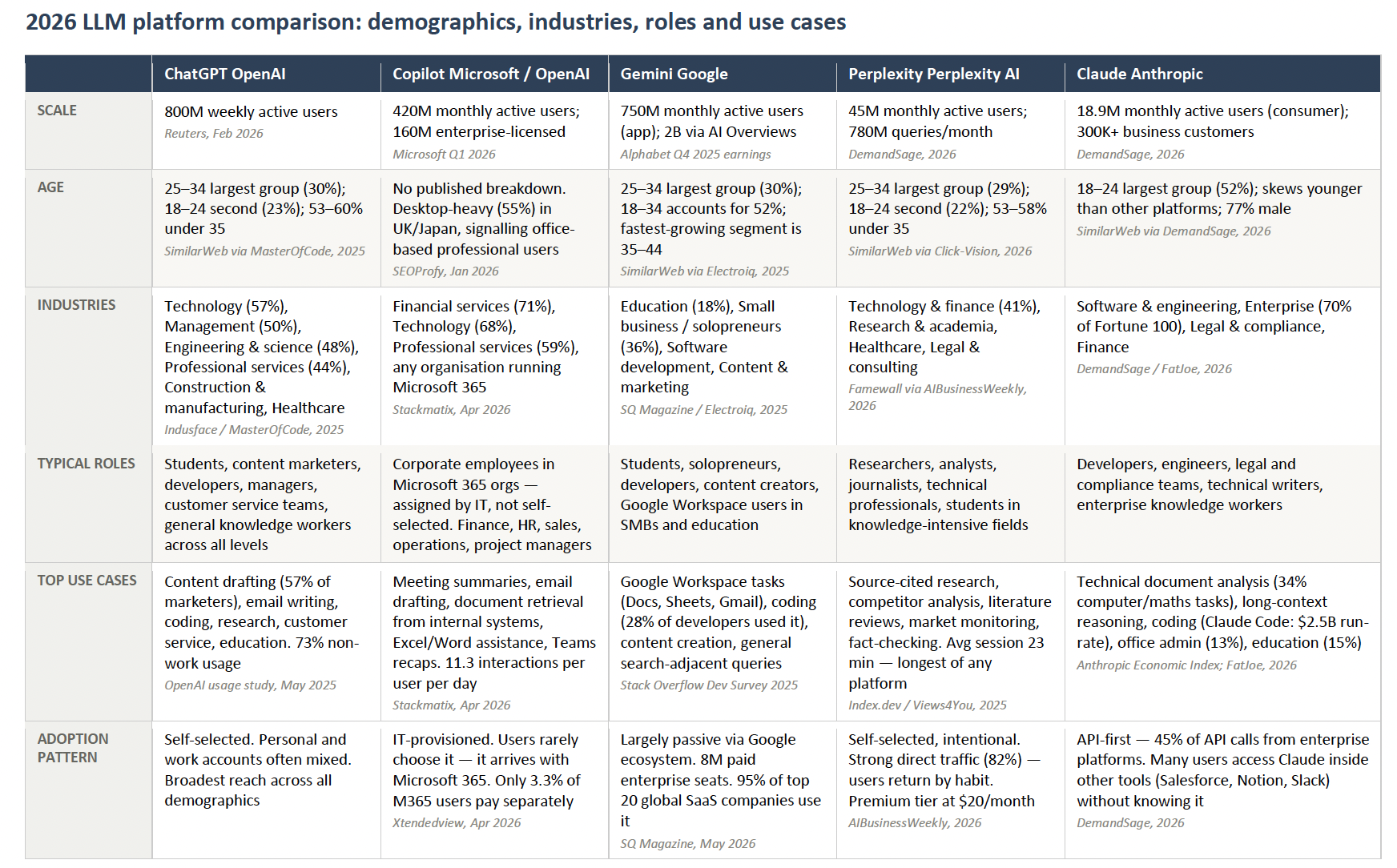
The answer depends on who your customer is
There is no single answer to "which LLM is my customer using?" but there are some clear patterns.
If your customer works in a large organisation running Microsoft 365…
The most likely answer is Microsoft Copilot. This is not because they chose it, but because it arrived with their software suite. Copilot has 420 million monthly active users and 160 million enterprise-licensed seats. Financial services (71% adoption) and technology (68%) lead the pack, followed by professional services at 59%. These aren't people who downloaded an app. It's sitting inside Word, Outlook, and Teams — it's simply there.
If your customer is a researcher, analyst, or technical professional…
They're most likely using Perplexity for sourcing and verification tasks. 41% of Perplexity's active users work in knowledge-intensive industries like technology and finance. The average session runs 23 minutes, the longest of any AI platform.
If your customer is a developer, engineer, or enterprise knowledge worker…
Claude is increasingly the tool of choice for complex, document-heavy tasks. It's embedded in tools used by over 70% of Fortune 100 companies, and its enterprise retention rate of 88% is well above the industry average of 76%.
If your customer is a small business owner, content professional, or generalist…
They're almost certainly using ChatGPT. With 800 million weekly active users and the broadest demographic reach of any platform, it's the tool most people encounter first and return to most often. 57% of content marketers use it for drafting. It's the default.
If your customer is a Google Workspace user (especially in education or SMBs)…
then Gemini is increasingly their ambient AI. It's built into the tools they already use, and with 750 million monthly active users and 95% of the top 20 global SaaS companies now using it, its reach is growing fast.
Why this matters for your visibility
The majority of buyers start broad on Google, structure their research using LLMs, validate with peers, verify on brand websites, then return to peers for the final decision. LLMs aren't replacing the buying journey but they are reshaping part of it.
According to Magenta Associates' 2025 survey of 300 UK B2B purchasing professionals, 85% of buyers aged 25–34 use AI for supplier research, compared to just 23% of buyers aged 55–64. While the data is UK-specific, the pattern aligns with broader global research on generational AI adoption. The 25–34 are today's procurement leads, project managers, and evaluation committee members. If you're invisible to AI-assisted research, you're invisible to these people building the shortlists right now.
So which one should you focus on?
All of them, but not equally, and not in the same way.
Start by identifying which platform your specific buyers are most likely using. A procurement manager at a manufacturing company running Microsoft 365 is a Copilot user. A research scientist sourcing materials is a Perplexity user. A developer evaluating APIs is likely a Claude user. A marketing director at a fast-growing startup is probably still on ChatGPT.
Each platform looks for information differently. ChatGPT rewards long-term web authority such as third-party mentions, published content, established domain presence. Copilot's external results run through Bing, not Google, so your Bing presence and LinkedIn activity matter more than most companies realise. Perplexity rewards fresh, source-cited, well-structured content that's easy to quote. Claude draws on Brave Search which is an independent index completely separate from Google. And this means your Google rankings don't automatically transfer.
The practical starting point isn't a complete strategy overhaul. It's an audit. Open each platform and type in the questions your buyers are actually asking about your category. See where you appear, where you don't, and who's appearing instead of you.