Why does my company show up in ChatGPT but not in Claude?
This is one of the questions I get asked all the time: “Why is it that when you type the exact same question into ChatGPT, Copilot, Perplexity, and Claude, my company shows up in one but not the others?”
The answer is because each tool is looking in a different place to build its answer, and each one makes different decisions about what it trusts.
That is why AI visibility varies so dramatically between platforms.
Research shows that only 12% of cited sources match across AI platforms for the same query. That means a brand visible in one tool could be invisible in two others regardless of how strong its website or SEO is.
So what is actually happening?
ChatGPT primarily draws from its training data.
This means your visibility is shaped by how much your brand exists across the broader web over time. That includes third-party articles, directories, published thought leadership, industry mentions, reviews, and other sources that help establish digital authority.
This is one reason established brands tend to perform well. According to Seer Interactive’s AI Visibility Study, approximately 70% of cited domains come from sources older than five years, while nearly 30% of citations come from 2022 or earlier. That helps explain why Wikipedia, major publishers, and long-established brands often dominate responses.
For newer companies, this creates a different challenge. Publishing a few strong pieces of recent content is helpful, but it does not automatically create visibility in a system that rewards long-term digital presence.
Microsoft Copilot looks at internal data first, then searches outside.
Even though it's also powered by OpenAI's models it pulls from two places: Microsoft Graph (your company's internal SharePoint, Teams, Outlook, and OneDrive) and Bing for external web results.
In practice, it prioritises internal context first. So if someone inside a business asks a work-related question, Copilot may look first at procurement systems, supplier documentation, product files, or internal knowledge before it reaches outside. That is why your product may show up in a Copilot query yet be absent everywhere else.
For broader queries, it goes to Bing and not Google. This matters for visibility because your presence in Copilot's external answers is really about your Bing presence, not your Google rankings. Plus, IT admins can disable web grounding entirely, meaning some employees may be working with a Copilot locked to internal data only.
This is why a supplier can have strong SEO and still be invisible to a procurement team asking Copilot for recommendations. There is also growing evidence that Copilot leans heavily on LinkedIn for B2B queries, which makes your company’s LinkedIn presence far more strategic than many teams assume.
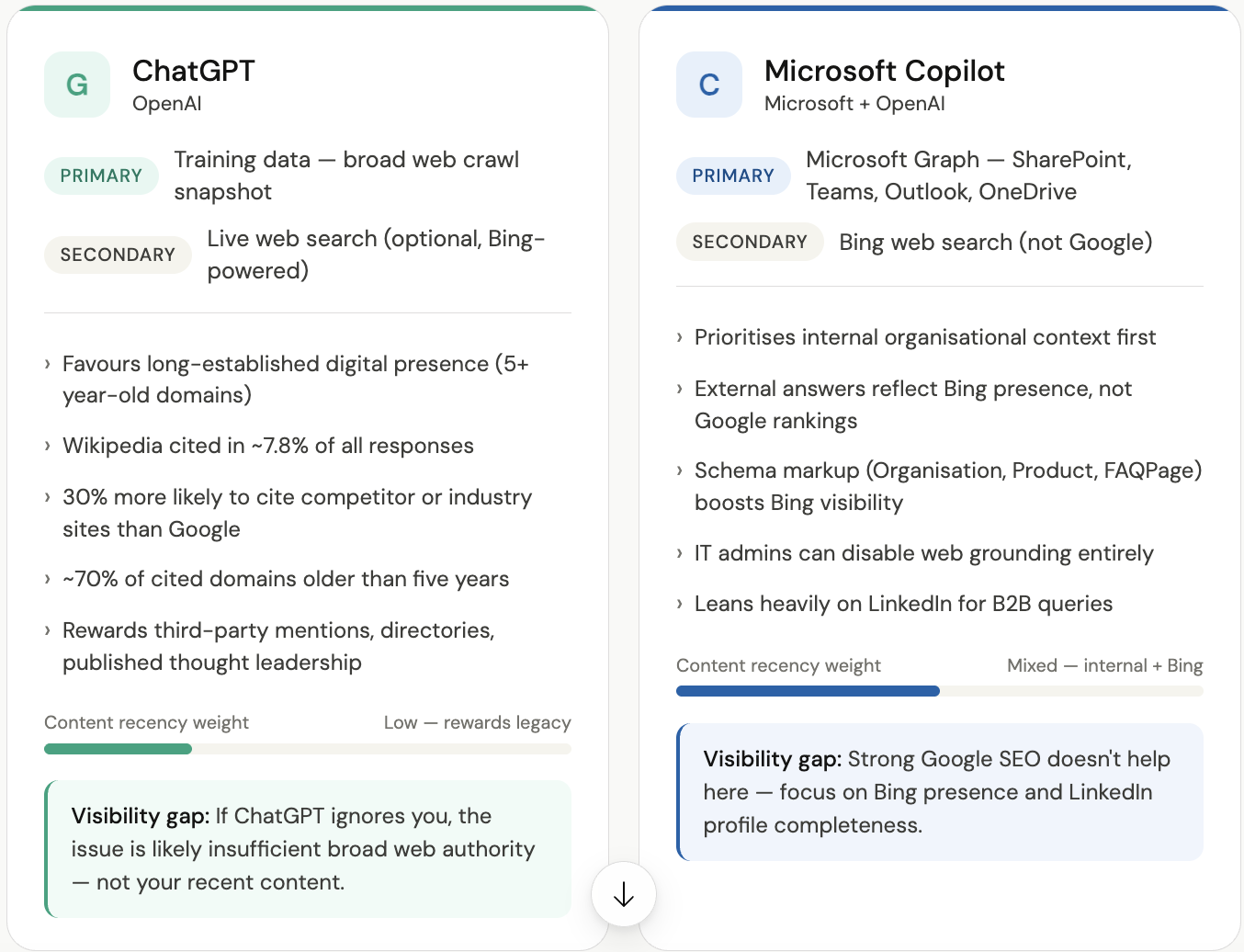
Comparison of how ChatGPT and Copilot look for information
Perplexity is more like a live research engine than a traditional chatbot.
Perplexity actively crawls the web for every query, pulls live sources, and automatically embeds source references directly within the text so you know where it found the information. It is highly responsive to fresh, recently published content.
Seer Interactives’ AI Visibility Study reveals that 80% of Perplexity’s citations came from content published between 2023 and 2025. So if you recently updated a technical white paper, datasheet, or FAQ, Perplexity may find and surface it far faster than ChatGPT.
Perplexity is also more demanding about source quality. If your content is overly vague, heavy on marketing language, or difficult to quote, it is more likely to be ignored in favour of something clearer and more structured. Data-rich content with strong headings, FAQs, tables, and precise explanations performs much better because the model can lift useful information quickly.
Claude doesn't use Google or Bing to find information.
It uses Brave Search, which is an independent search engine with its own web index built entirely from scratch.
According to Exposure Ninja’s 2026 AI Search Statistics Report, Brave Search's ranking algorithm prioritises greater emphasis on transparency signals such as named authorship, verifiable expertise, and cited data sources than traditional backlink-heavy search models like Google. For example, a named author linked to a verifiable profile (such as LinkedIn profile or a bio at an institution or company) sends a stronger signal than typical corporate copy (such as what is found on your webpage) with no attribution.
Claude also combines training data with live web access, so recency matters here too. Content that has been updated within the last year tends to perform better in AI retrieval systems than stale pages that have not been touched in years.
That does not mean constantly churning out new content for the sake of it. It means maintaining what already exists. Refreshing statistics. Updating pages as industries evolve. Making sure expertise is visible rather than implied.
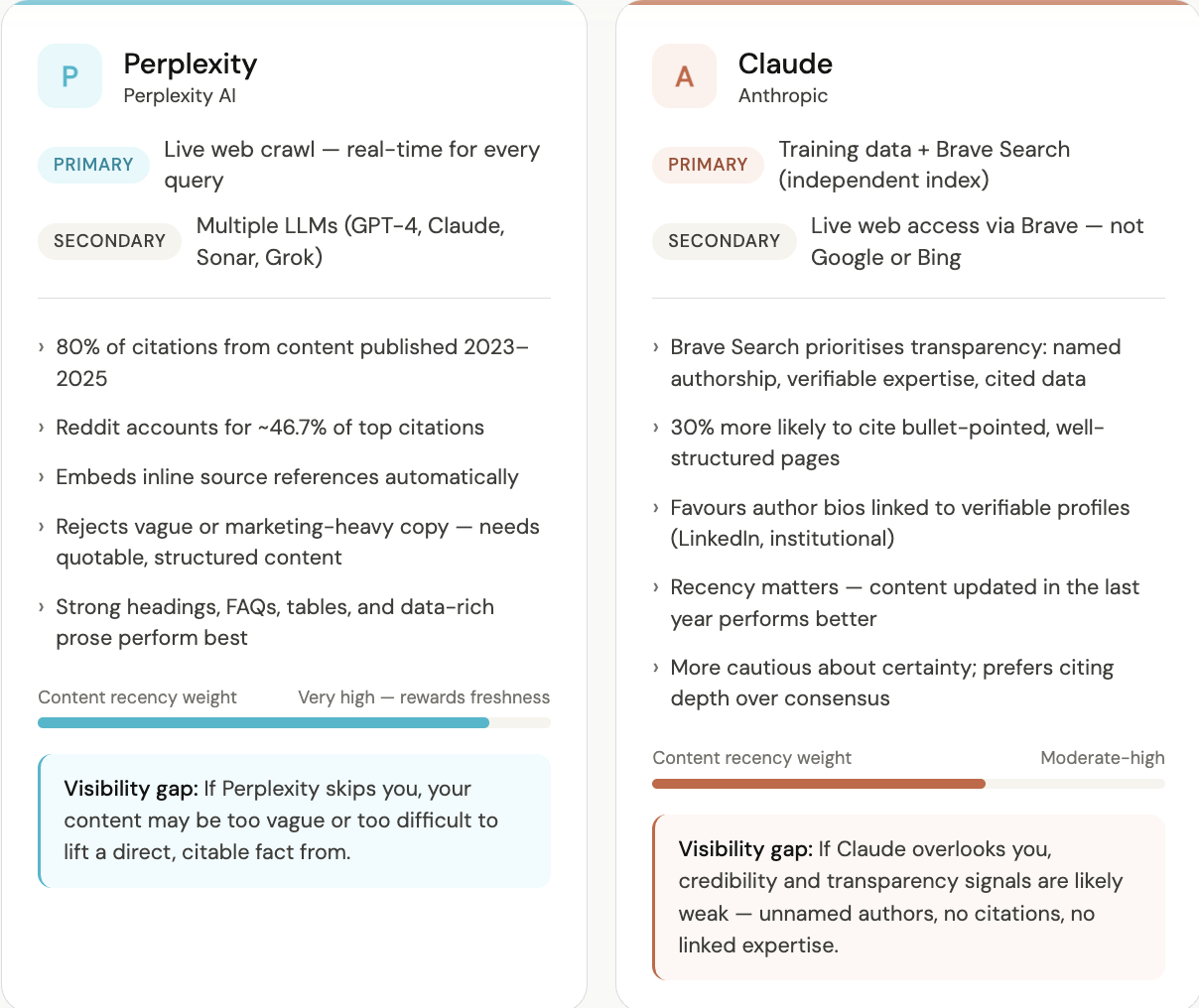
Comparison of how Perplexity AI and Claude AI look for information
So why does this matter for your AI visibility?
If your company shows up in one AI tool but not the others, it’s a gap you can fix. But first you need to know which gap.
If ChatGPT ignores you, the issue is likely broader web authority. If Copilot misses you, Bing visibility or internal discoverability may be the problem. If Perplexity skips over your content, it may be too vague or too difficult to quote. If Claude overlooks you, credibility and transparency signals may be weak.
Open each tool and ask the questions your buyers are actually asking. Keep in mind that they are not searching your company name. They are searching the problems they are trying to solve and technologies they are exploring.
Then look at who shows up. That exercise will tell you far more about your AI visibility than most analytics dashboards because it reveals not how your website performs in theory, but how AI systems actually interpret your digital presence.
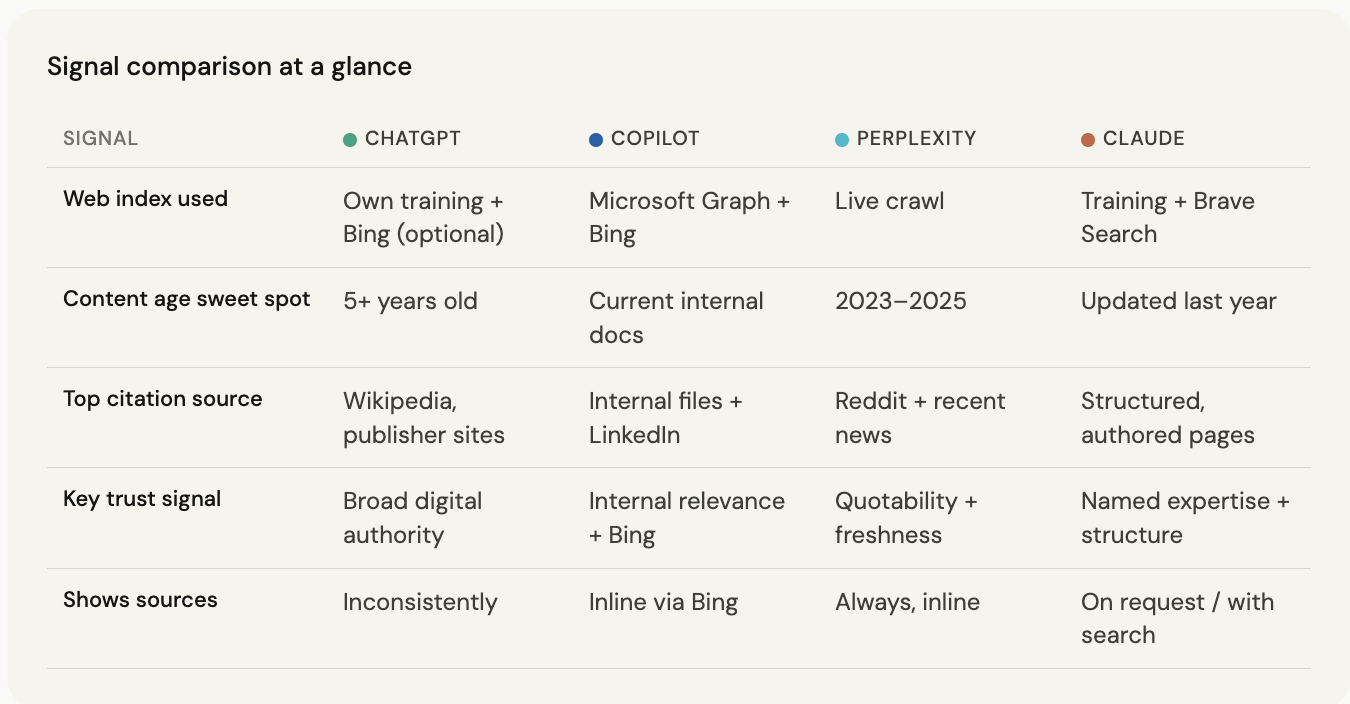
Snapshot of how LLMs like ChatGPT and Claude source content (June 2026)
Most communication and marketing teams have been optimising only for Google while your buyers have started looking for answers somewhere else entirely. The good news is that strong, well-structured content built on genuine expertise travels across all four platforms.
The challenge is understanding that each one has its own rules.